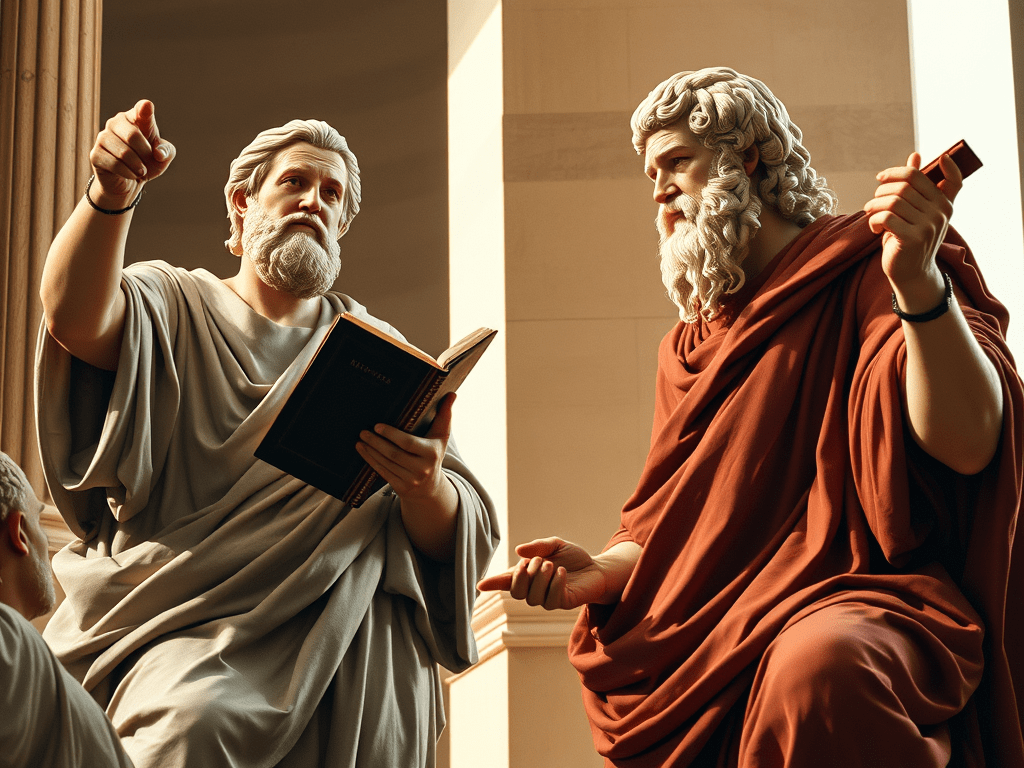
To determine whether Plato and Aristotle wrote for fundamentally distinct worlds, we must first analyse the motivations behind their respective tones, assess how external factors shaped their philosophies, and clarify what the “worlds” in question represent. An important starting point is Aristotle’s two decades of study at Plato’s Academy, which suggests Plato’s foundational influence on his pupil. Yet Plato’s idealism and Aristotle’s realism represent a striking contrast, particularly given their overlapping lifetimes and teacher-student relationship. In this essay, I will examine the political, ethical, and artistic philosophies of Plato and Aristotle, while contextualising their ideas within the socio-historical frameworks that some scholars argue constitute separate “worlds.”
We can look at Raphael’s famous painting The School of Athens to find the most wellknown visual representation of the difference in Plato and Aristotle’s ideologies and appearances. Initially, for a teacher and a student both born around the 4th century BC, one might assume that their ideas would be similar and follow each other’s philosophy. However, Raphael’s painting suggests, modelling Plato after Leonardo Da Vinci (centremost on the left), that Plato’s ideas embody a pursuit of obtaining a utopia which holds the spiritual ideas of truth, beauty and justice on the highest pedestal. (Wikipedia, 2025) Furthermore, Plato is shown as pointing towards the sky while holding a copy of Timaeus, whilst Aristotle gestures to the ground and props up a copy of his Ethics. Plato’s obsession with the sky and the cosmos can be linked to his theories of forms and the idea of the universe uniformly orbiting in a circular motion. Aristotle does the opposite as he seems to be concerned with the more earthly and worldly reality whilst gesturing to the ground. Symbolically, we can analyse this painting and understand how the two differed in the way that they wrote and potentially the very different worlds that they lived in.

Figure 1 – Raphael’s School of Athens (Wikipedia, 2025)
Plato’s The Republic emphasised the importance of how to think properly – in front of the academy “let no one enter that is ignorant of geometry.” Plato’s concept of the philosopher-king, as presented in his work The Republic, posits that the ideal ruler must be someone who loves knowledge and wisdom and understands the essence of justice. They must possess true knowledge of forms, math, and the form of the justice, and must be compelled to rule. This model reflects Plato’s belief in a hierarchical society where rulers possess superior knowledge and moral character, a notion that contrasts sharply with Aristotle’s governmental ideals that emphasise collective decision-making. Plato’s Republic has been said to be a church and not a state; such an ideal of a city in the heavens has always hovered over the Christian world – which is why Annas, 2003 says that Plato was the “most influential philosopher on Christianity”. (Annas, 2003)
Aristotle is regarded as a more grounded philosopher: through his use empirical evidence to support any of his claims he finds relationships first and invents a theory based off of this relationship. He treated his Lyceum as an informal school that was focused more on the idea of informality and spreading of good ideas. He wrote many of his most famous works during his time at the Lyceum including: “metaphysics”, “on the soul”, and “physics”, which is titularly strange as it discusses philosophy. This contrasts with the Academy that he was a part of and the one that Plato was the founder and teacher of. For Plato, everything in the world was perfect, atoms were geometrically perfect, and the entire universe was supposedly uniformly circular. Aristotle’s cosmology was similar, but he had 4 main sensations, with earth at the centre of the cosmos.
Aristotle theorised that life is based on a few “souls”: the vegetative soul, the sensitive soul and rational soul. Crucially, the way that it seems to come as a result of him studying people for a long time and empirically deciding that this was the nature of the world. Aristotle put forward the popular idea of the ladder of being working towards God. For Aristotle, his writing and philosophies focused on how the world worked – lots of his texts survived and his ideas were significant because of his manuscripts.
Regardless of the flaws in some of Plato’s ideas, 20th century philosopher Afred North
Whitehead claimed all western philosophy is written as simply a series of footnotes to Plato’s original philosophy. (Oglesby, 2018) For Plato, reason is the fundamental to finding the truth. Ruling was the craft that required being a master of your craft and this formed the basis for his philosopher-king ideals: Plato thought there should be a philosopher-king at the top of his ideal utopia.
Plato theorised that a woman’s womb was a live organ that moved around the body and led to disease in some cases; strangely, this theory was believed for centuries as doctors worked on it. However, Plato also claimed that women were comparable to children, and this laid the foundation for his more polarising scientific views that later became unfounded. (Plato, n.d.)
In Plato’s Republic, the ideal state transcends human selfishness and greed and social unity. This almost utopia sounds good fundamentally but there are no private properties or family. (Tom Griffith, 2000) Aristotle’s realistic contradiction features a working government and acknowledges the flaws of a human and tries to mitigate the effects of it. Aristotle puts this idea of human nature as being comparable to that of “political animals” forward. The purpose of the state exists to promote and protect the common good and enable citizens to achieve eudaimonia (flourishing). These governments are characterised by categories of good and bad: either a monarchy, aristocracy, polity or alternatively, tyranny, oligarchy and actually democracy. However, whilst both Aristotle and Plato both criticise democracy, Aristotle seems to concede that democracy is potentially a viable constitution if joined with another political system. (Politics, n.d.)
Aristotle, in his work Politics, introduces the contentious concept of “natural slavery,” arguing that certain individuals are slaves by nature, possessing only the capacity for physical labour and lacking the rational faculties necessary for self-governance. He claims that for these individuals, subjugation serves their best interest, as they benefit from the guidance of a natural master. This perspective is rooted in the socio-economic structures of ancient Greece, where slavery was an integral part of society. In stark contrast, modern ethical standards and human rights principles categorically reject slavery in all forms, viewing it as a profound violation of individual autonomy and dignity. These philosophical positions highlight the differences between the socio-political landscapes of ancient Greece and the contemporary world. Plato’s advocacy for rule by an enlightened elite and Aristotle’s justification of slavery were products of their time, reflecting societal norms and structures that are fundamentally at odds with modern values of democracy, equality, and human rights. However, there are many criticisms of Aristotle’s argument: his premise is mistaken, and humans lack the capacity to deliberate would benefit from competent guardians to look out for their welfare, as opposed to a lifetime of forced labour. Aristotle shows a strange lack of consideration for the abusive and degrading nature of slavery. Furthermore, his identification of those without the ability to think for themselves or to consider deliberation is flawed to some extent. Aristotle fails to understand that rather than a causal relationship between lacking the intelligence and being a natural slave, there is no inherent nature in this relationship. In fact, there is the argument to be made that it is the complete opposite: the reason for those that are thought to be “natural slaves” being in that position, is simply because they have been subjected to the confines of a lack of education. They have been forced to lack the initiative of deliberation and instead are forced to constantly think about how to serve their master. (Lowe, 2019)
Although Plato died before Aristotle’s official formation of his idea of natural slavery, there are still many ways that their philosophies differ in the area of hierarchy and the way that the natural order should occur. Plato similarly argues a ladder of hierarchy and bases it largely on the intelligence and knowledge; however, there are some nuances. Plato accepted slavery as a common feature of ancient Greek society. However, he discusses slavery pragmatically, focusing on how masters should treat slaves and how slaves should be managed for the benefit of the state. This opposes Aristotle’s beliefs to some extent as Aristotle mentions that natural slavery justifies exploitation, which Plato might have seen as destabilising to the social order. Furthermore, Plato’s emphasis on the malleability of the soul through education and his mention in Meno of Socrates’ demonstration that an uneducated slave can grasp geometrics with some education, helps to prove his point. Fundamentally, this undermines Aristotle’s claim of some people being “natural slaves” that lack the capacity for reason. Plato, though he was not able to physically respond, would have likely explained that hierarchy stems from the soul’s structure, not from fixed natural differences in human capacities. (Calvert, 1987)
Plato continually talks about the idea of a tripartite soul as well in his Republic. This tripartite soul or ψυχή is composed of three interdependent parts: the first being reason or σοφία and is concerned with the rational part of the brain that seeks truth, wisdom and logical order. It governs decision-making and aims to align the soul with the eternal forms. The second part of the soul is the spirit or the θυμοειδές. Through this we should be able to express courage, ambition and other emotions: it is the source of all these emotions, and it seeks honour, victory and recognition. The third part of the soul is appetite or ἐπιθυμητικόνand it encapsulates the key hedonistic desires such as food, thirst, material wealth and sex. In all three of these examples, we can find a reference or analogy in The Republic: the reason can be seen in Plato’s idealistic philosopher-kings; the spirit can be seen in the warriors that defend the state and enforce order; and the appetite can be seen in the way that farmers provide the state and people with basic physical needs such as food. (Tom Griffith, 2000)
Both Aristotle and Plato continually push the idea of reason and virtue as essential to a good life but differ in approach. Plato believes only a select few philosophers can achieve the highest peak in his ideal utopia, while Aristotle sees ethical development as open to all, bar the “natural slaves”, through practice. Plato’s ethics focus on an ideal society, while Aristotle’s is about individual moral development. We know that Plato is regarded as the man that is focused more so on the heavens and the cosmos, while Aristotle is more concerned with worldly issues. In this sense, we can argue that the two of them wrote for different worlds: Plato writes large parts of The Republic in the context of his ideal world with philosopher-kings at the top of it, while Aristotle is more realistic about his hierarchy. Although we can find many differences in the way and the worlds that Aristotle and Plato write in, it can still be seen that they similarly lived during a time of crisis and chaos in ancient Greek society: Athenian Democracy was declining, and Plato witnessed the fall of Athens in the Peloponnesian War and the execution of his mentor Socrates. At the same time, Aristotle had to live through the rise of Macedon under Alexander the Great, the man that conquered the entire world. They both tried to grasp the idea of a just and stable city-state: Plato through his idealistic state with philosophers at the top, while Aristotle through a more pragmatic empiricist mixed state. Nonetheless, they wrote for the same world in the sense of a failing Greek world, moral uncertainty and intellectual ferment. In examining Aristotle’s defence of natural slavery, it becomes evident that Plato and Aristotle were writing for relatively different worlds, shaped by distinct historical and philosophical landscapes. Aristotle’s argument—rooted in a teleological worldview that justified inherent human hierarchies—reflects the pragmatic realities of 4th-century BCE Greece, a society entrenched in slavery and shaped by Macedonian expansion. His assertion that some individuals are “natural slaves” underscores a worldview where social order was presumed static, aligning with the era’s acceptance of systemic inequality. In contrast, Plato’s Republic, while hierarchical, emphasizes the transformative power of education and reason, envisioning a meritocratic society where roles are determined by cultivated virtue rather than innate inferiority. In this sense, their works also share key similarities shaped by their shared Greek context. Both justified social hierarchy: Aristotle through innate human inequality, Plato through the tripartite soul’s structure. Both centred the polis as essential for human flourishing and stressed education’s role in cultivating virtue.
 ClassicsForEveryone
You must be logged in to post a comment.